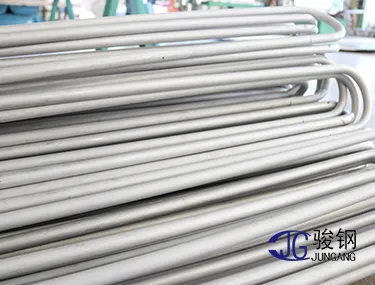
A stainless steel heat exchanger tube enquiry starts from the exchanger, not from a grade nickname. The designer needs a tube that matches the thermal duty, the tube-sheet joint, the bundle length and the corrosion case. The mill needs a product standard, a size with a wall basis, a length, a condition and an inspection list. A line that says only “316L heat exchanger tube” leaves both sides guessing.
Junda’s catalogue includes straight precision tube, U-pipe and rectangular heat-transfer tube. The heat-exchanger application page points at related product groups. It is a navigation page. It is not an approved materials list for a TEMA exchanger, a condenser or any particular fluid.
Choose the form from the drawing before you choose a catalogue photograph.
| Form | When it is the right question | Catalogue place to start | Drawing data the mill cannot invent |
|---|
| Straight tube | Bundle of cut lengths, ends to be expanded or welded | Austenitic pipes or precision tubing | OD or ID, wall basis, cut length, end condition |
|---|
| U-tube | Hairpin bundle with a specified bend | Stainless steel U-pipe | Bend radius, leg spacing, leg lengths, which dimensions apply after bending |
|---|
| Rectangular profile | Non-round passage where hydraulic diameter is part of the design | Rectangular heat-transfer tube | Outside and inside profile, corner radii, wall, and the flow dimension |
|---|
A U-tube is not a straight tube with a bend “to be arranged later”. Bending changes wall thickness at the extrados and intrados, and it changes the leg spacing that the baffle and the tube sheet see. The U-tube drawing guide lists the radii and lengths that belong on the enquiry. Send the drawing. A nominal radius without a tolerance is not a drawing.
A rectangular passage needs the same discipline. Hydraulic diameter calculated from a nominal outside size, with no corner radius and no wall, will not match the finished tube. The rectangular tube note shows why the profile has to be dimensioned. Do not convert a rectangular enquiry into a round tube of “similar area” unless the thermal design has been redone.
Straight lengths still need a length rule. Say whether length is a minimum, a cut length with a tolerance, or a random range. Extra length that cannot enter the tube sheet is scrap. Short length that cannot be expanded is scrap. The extra-long tube guide covers the transport limit when a single length replaces a butt weld. If your specification forbids circumferential welds in the tube, say that. Do not leave it implied by the word “seamless”. Seamless refers to the tube body. It does not describe a later butt weld between two lengths unless you forbid that weld.
Which specification names the tube?
Product form and specification are a pair. ASTM A213/A213M-25 addresses seamless ferritic and austenitic boiler, superheater and heat-exchanger tubes. ASTM A269/A269M-25 addresses austenitic tubing for general service. ASTM A312/A312M-25 addresses austenitic pipe. A heat-exchanger duty does not silently convert pipe into A213 tube. The standard-selection guide compares those public scopes.
ASTM A1016/A1016M-24a states general requirements for several tube specifications, including the relationship between the product specification and a more demanding order. Use it when the product specification points to it. Do not paste it onto an A312 pipe order and assume the tube rules follow.
For each item, write the specification, the edition year, the grade and the manufacturing route. If the designer allows only seamless, write seamless. If average wall is required, write average wall. If minimum wall is required, write minimum wall. A mill that prices nominal wall against a minimum-wall design will look cheaper and will not meet the drawing. Ask the quotation to repeat the wall basis in the same words you used.
Grades that appear in Junda’s austenitic catalogue, including 316L, 317L, 347H, 904L and 254SMo, are catalogue identities. The enquiry still has to name the grade exactly as the specification writes it. A dual-certified description, a later supplementary requirement or a corrosion test is an extra line. It is not included because the grade name looks familiar. High-temperature 347H and wet chloride service are different problems. Do not copy a grade from a neighbouring exchanger.
What inspection answers an exchanger failure?
Inspection follows the failure you are buying against. A tube that must hold pressure needs the leak test the specification requires. A tube that will be expanded into a tube sheet needs end condition, ovality and a wall that still satisfies the joint. A tube in a service where pitting matters needs the corrosion and surface requirements the designer named, not a generic “NDT included”.
Junda publishes hydrostatic equipment, an ultrasonic and eddy-current line, chemical analysis, mechanical testing, metallography and intergranular-corrosion equipment. Testing capabilities Map those words onto the specification. Do not rename them.
| Question the bundle asks | Enquiry line that answers it | Published capability you can ask about |
|---|
| Will the tube hold the test pressure? | Hydrostatic test pressure, hold time and who calculates the pressure | Hydraulic pressure testing machine |
|---|
| Are longitudinal defects of concern on thin wall? | Eddy-current or ultrasonic method, calibration standard, coverage | Automated UT/ET system; see the method guide |
|---|
| Is the heat the grade on the drawing? | Chemical analysis to the product specification, plus PMI only if you define it | Spectrometer and carbon-sulfur analyzer; handheld analyzer is not a full PMI procedure |
|---|
| Will the ends expand or weld? | End squareness, burr, ovality, and any hardness limit after bending | State the measurement; do not infer it from straightening equipment |
|---|
| Is intergranular attack a specified risk? | The test method and acceptance in the product specification | Intergranular corrosion equipment, only if the order requires that test |
|---|
ASTM E1476 is a guide to sorting and identification methods. It can help you write a PMI rule. It is not itself the heat analysis. The eddy-current guide explains why a flaw-detection procedure needs a reference standard. Naming “ET” without that reference does not define sensitivity.
U-bends need one more decision. Say whether eddy current or another test is required before bending, after bending, or both, and whether the bend region is included. A test performed only on the straight mother tube does not examine the extrados after forming.
How should the commercial line stay comparable?
Split the enquiry so two mills can answer the same item. One workable structure is:
- Service summary the supplier may not change: fluid, temperature, pressure and any chloride or acid note the designer has already fixed. If those figures are confidential, say “as drawing” and attach the drawing under your own control.
- Product line: form, specification and edition, grade, seamless or other route, size, wall basis, length, quantity.
- Condition and surface: heat treatment, pickling or other finish, end protection.
- Bending or profile: attach the drawing and state the governing dimensions.
- Inspection and documents: tests, coverage, certificates, marking, and whether a third party will witness.
- Delivery constraint: maximum shipping length, Incoterms rule and named place, packing limits. The packing guide is the checklist. Junda does not publish a default packing method.
Ask for deviations in a separate column. A quotation that substitutes welded tube, nominal wall or a different specification edition should be visible before the price is compared. The RFQ checklist uses the same discipline for any product, not only exchanger tube.
Company range and capacity do not confirm that a U-bend radius or a rectangular profile is available. The published window is φ6–φ630 mm outside diameter and 0.2–80 mm wall for the company, not a qualified range for every profile. Ask the reply to state the sizes it is offering.
Send the drawing and the six blocks through the contact page. Keep the exchanger tag number on the enquiry so the answer cannot be reused, silently, for a different unit.