
Duplex & high-alloy
2205 vs 2507 Duplex Pipe: Compare the Grade Before the Category
Compare standard duplex 2205 with super duplex 2507 using traceable material references, and learn how to handle an ambiguous catalogue designation.
Prepare an S32750 super duplex tubing enquiry with the correct product standard, wall basis, service conditions and inspection requirements.
Junda Pipe
Published Reviewed
Bring this article into your own conversation.
For super duplex tubing, specify the exact grade, tube dimensions, wall basis, product standard, supplied condition and inspection requirements. S32750 is a commonly used super duplex designation, but the grade alone does not establish a pressure rating, corrosion guarantee or complete purchase specification. IMOA material background
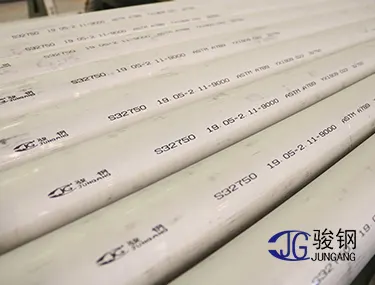
Junda lists an S32750 super duplex steel pipe entry. Catalogue source If the requirement is tubing, ask for confirmation against the required tubing standard and dimensions rather than assuming the pipe entry covers every tube order.
| Required form | Scope-level reference | Detail to resolve |
|---|---|---|
| Duplex tubing | ASTM A789/A789M-24 | Average wall or minimum wall when specified, dimensions and full product requirements |
| Duplex pipe | ASTM A790/A790M-24 | Pipe dimensional basis, manufacturing route and supplementary requirements |
The public scopes distinguish these product forms. They do not establish compliance of a quotation. Obtain the full standard and agreed edition for the actual order.
Record fluid composition, chlorides where relevant, normal and upset temperatures, pressure, flow and stagnant conditions. Include the cleaning and shutdown environment. For a heat exchanger, identify both sides of the tube; one material surface may see a different environment from the other.
IMOA identifies 2507/S32750 among common super duplex grades and discusses marine and chemical-processing applications. An application category is not approval for every seawater or chemical exposure. Provide the actual conditions for material assessment.
The inspection package should address the requirements of the selected standard and project. Ask the responsible engineer which heat-treatment records, mechanical properties, corrosion or microstructural examinations are required and how samples relate to the delivered lot.
ASTM A923-25, scope 1.4 states that compliance with chemical and mechanical product requirements does not necessarily indicate the absence of detrimental phases. Therefore, a satisfactory chemistry table cannot close every metallurgical concern. A923 methods also have specific grade and sampling limits; select them from the complete standard.
Use a sequence that keeps decisions connected:
For a preliminary comparison, keep dimensions and inspection identical across offers. If a supplier proposes another duplex grade, require a separate technical review rather than treating all super duplex names as equivalent.
Send the completed specification through the Junda contact page. For a material-family comparison, see 2205 versus 2507; for a chemistry screening calculation, see the PREN guide.
Links to standards bodies and material producers are provided for reference. Confirm the applicable edition, project requirements and acceptance documents for each order.
Duplex & high-alloy
Compare standard duplex 2205 with super duplex 2507 using traceable material references, and learn how to handle an ambiguous catalogue designation.
Duplex & high-alloy
Calculate PREN from an illustrative stainless steel chemistry and understand why it cannot replace corrosion testing or material approval.
Duplex & high-alloy
Compare high-alloy austenitic and super duplex pipe by service evidence, fabrication and inspection instead of ranking them by alloy name alone.
Send the grade, dimensions, quantity and required documents with your enquiry.