
Heat-resistant grades
347 vs 347H Stainless Steel Pipe: What Changes in the Order?
Understand why 347 and 347H need separate purchase requirements, and review creep duty, product form and certificates before substitution.
Compare 800-series designations using the original alloy bulletin and learn why a catalogue label such as 800T needs written confirmation.
Junda Pipe
Published Reviewed
Bring this article into your own conversation.
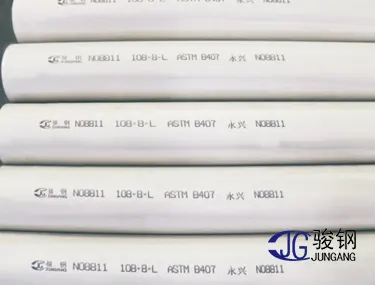
Alloy 800, 800H and 800HT are distinct purchase designations. Confirm the full material name, UNS designation, product standard and supplied condition before comparing quotations. A shortened catalogue label such as “800T” should be clarified in writing; it should not be silently expanded to 800HT.
Junda’s catalogue uses the name Incoloy 800T Seamless Pipe. Catalogue source That name identifies the enquiry entry, while its exact correspondence to an 800-series specification remains a matter for confirmation.
The Special Metals 800H and 800HT bulletin, pages 1–2, compares the three alloys. Its Table 1 includes the following designations and carbon limits:
| Alloy in the bulletin | UNS designation | Carbon, mass % |
|---|---|---|
| 800 | N08800 | 0.10 maximum |
| 800H | N08810 | 0.05–0.10 |
| 800HT | N08811 | 0.06–0.10 |
These are values from the manufacturer’s bulletin, accessed 25 October 2026. They are not Junda heat analyses or a complete purchasing specification. The bulletin also distinguishes controlled aluminium and titanium content, grain requirements and thermal treatment; carbon alone cannot establish equivalence.
Special Metals explains that 800HT has requirements within, but more restrictive than, relevant 800H limits. Material meeting N08810 does not automatically qualify as N08811. Bulletin discussion
A chemistry result falling within the displayed carbon range is only one part of the review. Check the full ordered product requirements, condition and documentation. A supplier’s combined label should be supported by explicit compliance statements for the delivered material.
The bulletin contains historical design-code information. Use current project-controlled code requirements for a new design rather than copying historical allowable stresses or temperature limits from an explanatory brochure.
Keep the catalogue wording visible and request four items: the exact proposed UNS designation; the product specification and edition; the supplied condition; and the certificate wording. Ask whether the offer is an exact match or a proposed alternative to the drawing.
If the response identifies 800H or 800HT, evaluate that material against the project requirement and record the accepted designation on the order. If the supplier cannot establish the mapping, leave the line unresolved. Correcting the label by assumption would remove the evidence of the uncertainty without resolving it.
Provide the operating and design temperatures, pressure, duration and cycling, process atmosphere, dimensions and required inspection. These inputs support the engineering review; the supplier’s confirmation of availability does not itself approve service suitability.
Send the requirement through the Junda contact page. Include the source bulletin when explaining which 800-series grade the project requires. The high-temperature enquiry guide offers a service-data structure, while its 347H material discussion should not be transferred to an 800-series alloy.
Links to standards bodies and material producers are provided for reference. Confirm the applicable edition, project requirements and acceptance documents for each order.
Heat-resistant grades
Understand why 347 and 347H need separate purchase requirements, and review creep duty, product form and certificates before substitution.
Heat-resistant grades
Prepare a 347H pipe enquiry with design temperature, duration, cycling, material condition and inspection requirements instead of a temperature label alone.
Send the grade, dimensions, quantity and required documents with your enquiry.