
Tubing & fabrication
Precision Stainless Steel Tubing: Specify the Dimensions That Matter
Define OD, ID, wall, ovality and straightness for precision stainless tubing, with an illustrative tolerance stack and drawing review checklist.
Use finished OD, bore and machining allowances to define thick-wall stainless pipe stock, with an illustrative geometry calculation.
Junda Pipe
Published Reviewed
Bring this article into your own conversation.
Specify thick-wall stainless pipe stock from the finished component’s geometry, machining plan and required material condition. A thick wall alone does not establish that the bore, outside diameter or available machining allowance will suit the part. Keep starting-stock acceptance separate from the finished component’s design approval.
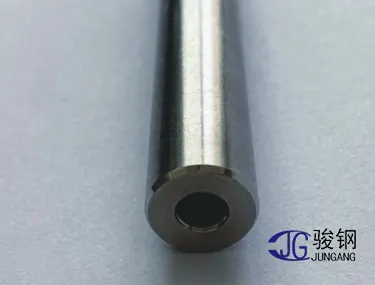
Junda lists fine-rolled thick-walled stainless steel pipe. Catalogue source Its name is an enquiry starting point; the required OD, ID, wall and tolerance must be confirmed for the order.
Consider an illustrative finished cylindrical part with 60.0 mm OD and 40.0 mm ID. Suppose the machining plan calls for 1.0 mm radial allowance on the outside and 0.5 mm radial allowance at the bore.
The nominal starting geometry would be:
These are geometric assumptions for explaining radial versus diametral allowance. They are not a recommended machining allowance, Junda stock size or pressure calculation. Actual tolerances, eccentricity, setup and process requirements must be included by the responsible manufacturing engineer.
A nominal starting wall can look sufficient while the allowed OD and bore variation leave less stock at a local position. Review the smallest acceptable OD and largest acceptable ID against the machining requirement. Include eccentricity or concentricity requirements where the finished part depends on them.
Avoid writing “extra material for machining” without values and a basis. State whether allowances are radial or diametral, whether the bore is to be machined, and which surfaces establish the machining datum.
| Starting-stock review | Finished-component review |
|---|---|
| Ordered material and product specification | Applicable component design requirements |
| OD, ID or wall basis and tolerances | Final dimensions and geometric tolerances |
| Length, end condition and surface allowance | Machined surface and connection requirements |
| Material examination and traceability | Final examination and design acceptance |
The table helps assign responsibilities. Receiving acceptable stock does not approve the finished component’s pressure or structural duty.
ASTM A312/A312M-25 is a product reference for austenitic pipe where specified by the project. ASME B36.19M addresses standardized pipe dimensions. A dimensional schedule should not be treated as an independent pressure rating or as a guarantee of machining allowance.
Provide the grade, standard and edition, required condition, starting dimensions, tolerance basis and inspection requirements. If custom dimensions are proposed, require explicit confirmation of the applicable requirements and deviations.
Send the finished drawing and starting-stock proposal through the Junda contact page. Include the machining engineer’s allowance basis so the technical response can address the actual requirement rather than the vague label “heavy wall.”
Links to standards bodies and material producers are provided for reference. Confirm the applicable edition, project requirements and acceptance documents for each order.
Tubing & fabrication
Define OD, ID, wall, ovality and straightness for precision stainless tubing, with an illustrative tolerance stack and drawing review checklist.
Tubing & fabrication
Prepare thin-wall tubing requirements for geometry, end condition, inspection coverage and packaging, with a receiving inspection sequence.
Tubing & fabrication
Compare continuous long tubes with joined lengths using an illustrative joint count, then define straightness, inspection and transport requirements.
Send the grade, dimensions, quantity and required documents with your enquiry.