
二相・高合金
S32750スーパー二相チューブは規格と肉厚基準を先に決める
S32750という鋼種だけでは、圧力定格も耐食保証も購買仕様も決まりません。製品規格、寸法と肉厚基準、使用条件、検査とサンプリングを順に確定し、引合いを組み立てる手順を追えます。
スラリー流体や腐食環境において、ゴムやフッ素樹脂ライニング鋼管の剥離・負圧座屈を克服し、スーパー二相鋼2507やニッケル合金管を選定するための技術比較と設計基準を解説。
Junda Pipe
公開 確認
Industrial pipelines transporting abrasive mining slurries, pulverized fly ash, phosphoric acid, and aggressive chemical tailings operate under severe simultaneous mechanical wear and electrochemical corrosion. Historically, process engineers selected carbon steel pipe lined with rubber, polyurethane, or fluoropolymers (PTFE, PFA) to handle these dual degradation mechanisms. However, polymer and rubber-lined piping systems possess well-documented operational failure modes: liner debonding under negative pressure, gas permeation blistering, severe thermal expansion mismatch, and joint turbulence erosion at flanged connections.
Where process reliability is critical, replacing lined carbon steel with solid corrosion-and-wear-resistant alloys—such as super duplex stainless steel UNS S32750 or nickel alloys—eliminates delamination risks, provides uniform mechanical resistance throughout the wall thickness, and withstands full vacuum and thermal cycling without liner failure.
Process engineers transition from lined piping to solid alloy seamless pipe primarily due to four recurrent operational failure mechanisms:
Solid alloy pipes resist abrasive slurry wear through high surface hardness and superior passive film self-repair kinetics. Duplex and nickel alloys outperform both carbon steel and conventional austenitic grades in high-chloride, solid-entrained media:
| Material System | Vickers Hardness (HV) | PREN Value | Max Service Temp (°C) | Vacuum Resistance | Relative Slurry Life |
|---|---|---|---|---|---|
| Carbon Steel + Rubber | 60–75 Shore A | N/A | 80 | Poor (liner collapse) | Baseline (1.0x) |
| 316L (UNS S31603) | 160–190 HV | 25 | 400 | Full vacuum | 1.5x–2.0x |
| 2205 (UNS S32205) | 260–290 HV | 35 | 300 | Full vacuum | 3.0x–4.5x |
| 2507 (UNS S32750) | 290–320 HV | 42+ | 300 | Full vacuum | 5.0x–8.0x |
| Hastelloy C-276 (N10276) | 210–240 HV | 68+ | 450 | Full vacuum | 6.0x–10.0x |
Super duplex 2507 combines high matrix hardness (290–320 HV) with exceptional pitting resistance (PREN 42), providing an optimal balance of abrasion resistance and chemical immunity against sour slurries containing suspended quartz and pyrite particulates.
Specifying solid alloy seamless piping for abrasive services requires calculating corrosion-erosion allowances () and establishing limiting slurry velocity thresholds:
All Junda alloy pipes undergo factory spectroscopic verification, wall ultrasonic gauging, and hydrostatic pressure testing at our testing capabilities facility, backed by our rigorous quality assurance program.
When preparing a technical purchase requisition to replace lined pipe with solid alloy seamless pipe, include these operational variables:
| Requisition parameter | Incomplete description | Recommended specification format |
|---|---|---|
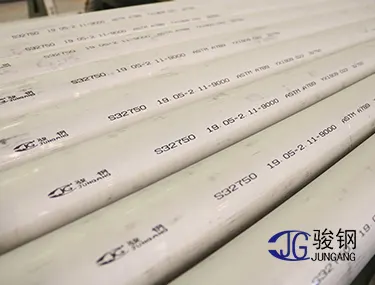
| Material specification | Super duplex pipe | ASTM A790 UNS S32750 seamless, solution annealed |
| Manufacturing condition | Standard seamless | Cold drawn, bright annealed or pickled, Ra ≤ 0.8 µm bore |
| Wall thickness allowance | Standard wall | ASME B36.19M 6" NPS Sch 80S (8.64 mm nom wall) |
| NDT method | Standard test | 100% Eddy Current + 100% Ultrasonic examination to ASTM E213 |
| Certificate type | MTC | EN 10204 Type 3.1 with heat chemistry, PREN ≥ 42, and hardness |
Review Junda's comprehensive line of super duplex steel pipes, or send your slurry chemistry and operating parameters directly through our contact page for a detailed technical proposal.
標準機関や材料メーカーへのリンクは参考情報です。適用版、プロジェクト要件、受入書類は発注ごとに確認してください。
二相・高合金
S32750という鋼種だけでは、圧力定格も耐食保証も購買仕様も決まりません。製品規格、寸法と肉厚基準、使用条件、検査とサンプリングを順に確定し、引合いを組み立てる手順を追えます。
二相・高合金
2205と2507はどちらも二相鋼ですが、設計と腐食の要件が異なります。両者を材料候補として並べ、S22053のような未確認のカタログ名をどう扱うか、何を確認してから比較するかを整理します。
二相・高合金
PRENは成分から計算できる指標ですが、腐食試験の結果でも海水用途の保証でもありません。公開式を使った計算例、入力データの出所の区別、引合いに書くときの条件を決められます。