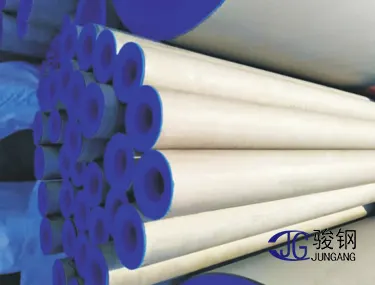
Select ASME SB-466 (ASTM B466) for seamless copper-nickel pipe and tube (UNS C70600, C71500) in marine and seawater cooling service, specify ASME SB-444 (ASTM B444) for seamless nickel-chromium-molybdenum pipe and tube including Inconel 625 (UNS N06625, plus N06852 and N06219), and order against ASME SB-407 (ASTM B407) for seamless nickel-iron-chromium pipe and tube across Alloys 800, 800H, and 800HT (UNS N08800, N08810, and N08811). All three standards govern seamless nonferrous pipe and tube exclusively, with SB-466 covering copper-base alloys and SB-444 and SB-407 covering high-nickel alloys.
Mills quote and certify material strictly against the governing specification number, UNS designation, delivery temper or heat-treatment grade, and non-destructive test scope. ASME Section II Part B publishes nonferrous pressure-equipment material specifications under the SB prefix, matching the corresponding ASTM B numbers. Purchase requisitions and mill test certificates must state both the specification number and the applicable edition year.
SB-466: a copper-nickel specification
Procurement teams frequently encounter SB-466 when searching for nickel-bearing piping, yet its metallurgical scope covers copper-nickel alloys. ASTM B466/B466M establishes requirements for seamless copper-nickel pipe and tube in straight lengths for general engineering applications. The covered grades are copper alloys UNS C70400, C70600, C70620, C71000, C71500, C71520, and C72200. Grades C70620 and C71520 control residual element limits for subsequent welding fabrication, while the pipe or tube itself remains seamless under B466.
Manufacturing routes progress from cast billets through hot extrusion or rotary piercing, followed by cold working and annealing. The purchase order must state the required delivery temper from the four B466 options: soft annealed (O60) or light drawn (H55), or the cold-worked tempers hard drawn (H80) and hard drawn with end annealing (HE80). Because temper directly determines tensile and yield strength, a requisition stating only "SB-466, C70600" leaves mechanical properties undefined.
Because SB-466 applies strictly to copper-base alloys, enquiries for Alloy 625 or Alloy 800 piping belong under SB-444 or SB-407.
SB-444: the 625 family, seamless and grade-dependent
ASTM B444 covers cold-worked seamless nickel-alloy pipe and tube in UNS N06625, N06852, and N06219. For UNS N06625, the specification defines two distinct heat-treatment grades. Grade 1 is annealed for service temperatures up to 1100 °F (593 °C). Grade 2 is solution-annealed for service above 1100 °F (593 °C) where high-temperature creep and stress-rupture strength govern design. Grades N06219 and N06852 are furnished in the solution-annealed condition only.
In SB-444, the grade designation sets the heat-treatment temperature and resulting allowable stress range. Pipe spools produced from the same UNS N06625 heat chemistry become different engineering products depending on whether they are heat-treated to Grade 1 or Grade 2. State the required grade immediately adjacent to the UNS number on the purchase order. Because subsequent hot-working or re-annealing alters mechanical properties, the mill certificate must record the actual heat-treatment condition rather than relying on the trade name.
Every SB-444 enquiry must establish both product form and exact alloy designation. Because the standard covers seamless nickel-alloy pipe and tube exclusively, welded products require a separate welded specification. And because the standard covers three distinct UNS compositions, requisitions must state UNS N06625 and the grade rather than "Alloy 625" alone.
SB-407: the 800 family and the annealed condition
ASTM B407 governs cold-worked or hot-finished annealed seamless nickel-iron-chromium pipe and tube in UNS N08120, N08800, N08801, N08810, N08811, N08890, and N06811. The specification divides these alloys by design temperature regime. UNS N08800 and N06811 are intended for service up to and including 1100 °F (593 °C). UNS N08120, N08810, N08811, and N08890 are designed for creep-limited service above 1100 °F and undergo high-temperature solution annealing to achieve a controlled coarse grain size.
The alloys commonly referred to as 800, 800H and 800HT correspond to UNS N08800, N08810, and N08811. Purchase orders must specify both the exact UNS number and the annealed delivery condition. For the creep-resistant grades (N08810 and N08811), the metallographic ASTM grain-size test result on the mill certificate verifies that the solution anneal achieved the required structure. Because ASTM B407 permits both cold-worked and hot-finished manufacturing routes, specify the required finish route on the line item when project design codes mandate one.
Common requisition errors on mill enquiries
Several recurring specification errors delay mill quotations and order entry:
- A tube dimension line copied onto a pipe order. All three specifications cover both pipe and tube. The dimensional callout on the order separates the two product forms. Pipe is ordered by nominal pipe size (NPS) and wall schedule, whereas tube is ordered by outside diameter (OD) and minimum or average wall thickness. Mixing tube and pipe dimensioning forces technical clarification before production. Our guide to pipe versus tube explains the tolerance rules for each system.
- A welded alternative offered against a seamless-only standard. SB-466, SB-444, and SB-407 apply strictly to seamless products. Any welded pipe or tube offer must be certified under its corresponding welded ASTM/ASME specification. Confirm the exact governing standard before award.
- A commercial trade name used without a UNS designation. Material standards classify alloys by UNS number. Project datasheets often use commercial names such as Inconel 625 or Incoloy 800HT. Purchase orders and mill test certificates must state the official UNS designation listed in the standard scope.
- An unspecified delivery condition or non-destructive test option. B444 defines two heat-treatment grades, B466 defines four tempers, and B407 requires controlled grain size on high-temperature grades alongside a choice between hydrostatic testing and non-destructive electric (eddy-current) examination. Leaving condition or test selection open delegates that engineering choice to the mill.
Requisition parameter to specification field
The middle column identifies where each specification defines the requirement, and the right column shows the exact wording needed on the purchase order.
| Requisition parameter | Specification clause | What to write on the order |
|---|
| Alloy | Scope alloy list, by UNS number | Exact UNS number such as N06625, N08811, or C70600 |
|---|
| Document and edition | Title and edition of the specification | ASTM B444 or ASME SB-444, with the edition named |
|---|
| Product form | Scope: seamless nonferrous pipe and tube | Seamless, and whether the item is pipe or tube |
|---|
| Size | Dimension clauses that follow the form | NPS and schedule for pipe, or outside diameter and wall for tube with the wall basis |
|---|
| Condition | Grade in B444, temper in B466, anneal and grain size in B407 | Grade 1 or Grade 2, temper O60, H55, H80 or HE80, or annealed condition with verified grain-size result |
|---|
| Tests and records | Chemical, tensile, hardness, grain-size, hydrostatic, NDT and eddy-current requirements | The tests required, their extent, and the results to appear on the mill certificate |
|---|
Required test evidence on the mill certificate
Check each test certificate from the mill directly against the mandatory test clauses of the specification:
- SB-466: Confirm the alloy UNS number and temper designation alongside ladle and product chemical analysis. Check room-temperature tensile properties, Rockwell hardness, expansion and flattening test results, and non-destructive eddy-current examination.
- SB-444: Confirm the UNS number and heat-treatment grade (Grade 1 or Grade 2) together with chemical composition across all specified elements. Check room-temperature tensile results, hydrostatic pressure test records, and non-destructive electric test results.
- SB-407: Confirm the UNS number and annealed delivery condition alongside complete chemical analysis. For N08120, N08810, N08811, and N08890, verify the metallographic ASTM grain-size number together with tensile properties and hydrostatic or eddy-current test verification.
A mill test report that lists chemical composition and room-temperature tensile values must also state the exact temper, grade, or annealing condition to confirm compliance. Check the delivery condition immediately after verifying the UNS number, and specify the required inspection certificate type (such as EN 10204 3.1 or 3.2) on the purchase order.
Junda's high-nickel alloy pipe range covers ASTM B407, ASTM B444, and their ASME SB code editions. Our product pages for Inconel 625 pipe and Incoloy 800HT pipe describe the thermal controls for each grade, and our page on testing capabilities lists the factory inspection methods. Submit your line schedule with UNS number, grade or temper, and testing requirements through the contact page.