A seawater or offshore pipe enquiry is a service description plus a material proposal. It is not a request to “use super duplex” because the location is offshore. Temperature, oxygen, chloride, crevices, velocity and whether the metal is coupled to another alloy decide the corrosion question. The catalogue can show which families Junda lists. It cannot approve a material for a platform, a ballast line or a desalination unit.
Junda publishes an offshore drilling page and a shipbuilding page. Both are navigation. Operating conditions, product fit and case studies on those routes are not filled with project data. Treat them as a way to reach the product groups, then write the service yourself.
What has to be true before a grade is even plausible?
Write the water before you write the alloy. These are the fields that change a technical answer:
| Field | Why it changes the offer | What to record |
|---|
| Water type | Open seawater, brackish, produced water, desalination brine and chlorinated water are different | Source, or “as process datasheet” plus the attached sheet |
|---|
| Chloride and temperature | Corrosion data without both is not comparable | Units, normal and upset values |
|---|
| Oxygen or deaeration | A deaerated system is not the splash zone | Aerated, deaerated, or unknown |
|---|
| Crevices and deposits | Gaskets, sleeves and stagnant zones dominate some alloys | Where crevices are designed in |
|---|
| Velocity and solids | Erosion and stagnation are opposite problems | Design velocity and any sand |
|---|
| Galvanic couples | A tube in a less noble tube sheet is a different case | The other alloys in contact |
|---|
| Design life and inspection access | A material that cannot be inspected needs a different margin | Who accepts that margin |
|---|
Do not fill unknown cells with typical ocean values and then treat them as the project. If the designer has not issued the datasheet, say the enquiry is preliminary and forbid substitution. The RFQ checklist shows a preliminary request that keeps those gaps visible.
PREN is a screening index calculated from a composition. It is not a corrosion test and it is not a ranking of catalogue families. The PREN note shows the arithmetic and the limit. Use it to see whether two certificates are even in the same conversation. Do not use a single PREN cutoff, copied from another project, as the purchase specification.
Which catalogue group matches which question?
Junda lists the families buyers usually open for this problem. Opening a group is not a selection.
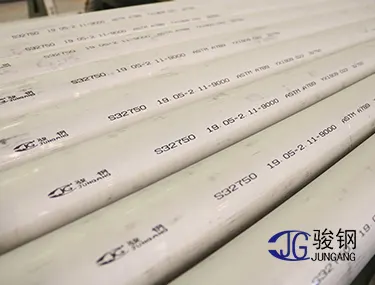
Super duplex and duplex entries sit in the super duplex group. The named detail pages are S32750 and S22053. S32750 is a super duplex identity that still needs a product standard, a size and a heat-treatment record. S22053 is the designation printed in this catalogue. Do not silently replace it with 2205, S32205 or S31803. The 2205 and 2507 comparison explains why those names are not interchangeable, and the S32750 tubing note lists the enquiry fields for that grade. Duplex mechanical properties and corrosion resistance depend on the phase balance after processing. Chemistry on a certificate, without the heat-treatment and microstructure checks the specification requires, is incomplete. The duplex inspection guide is the list to attach.
High-alloy austenitic and nickel-alloy questions start in two places. 254SMo is in the austenitic group. C-276 and the other nickel-alloy names are in the high-nickel group, including the C-276 detail page. The super austenitic and super duplex comparison is a review method, not a winner. The C-276 corrosion-data note shows how to read a chart only inside its stated concentration and temperature. A seawater chart does not answer a chlorinated, hot, crevice case unless the chart was built for that case.
Other high-nickel names on the same group page, including alloy 800, 825, 600, 625 and 400 identities, are catalogue labels. Alloy 800-series names in particular need the full designation. The 800, 800H and 800HT note shows the trap in a shortened label such as 800T. Those alloys are often asked about for temperature, not for seawater. Do not move them into a seawater shortlist because they share a webpage.
What will the fabrication and the inspection change?
A grade that survives a coupon test can still be the wrong purchase if the weld procedure, the heat treatment or the crevice is undefined.
Ask the reply to state:
- The product standard and edition, the grade designation as that standard writes it, and seamless or welded.
- The corrosion evidence the seller is relying on: a standard test required by the specification, a published datasheet with its limits, or no corrosion evidence at all. “Suitable for seawater” is the last of those.
- Whether fabrication is included. Junda’s published route is pipe manufacturing, not a statement that the works welds spools for an offshore specification. If you need welded assemblies, that is a different scope and must be quoted as such.
- The heat-treatment condition and, for duplex, the tests the specification uses to confirm it.
- Nondestructive testing, hydrostatic testing and any corrosion test, with coverage and acceptance. The published laboratory list is on the testing page. A listed method is not already included in the price.
- Whether cathodic protection, chlorination or acid cleaning is in the operating procedure. Those are designer inputs. A mill should not invent them.
Published company dimensions, φ6–φ630 mm outside diameter and 0.2–80 mm wall, and capacity above 10,000 tonnes, are company totals. They do not show that a super duplex size is in stock or that a nickel-alloy size has been made. The ISO 9001 record transcribed on the quality page covers manufacture and sale of stainless steel seamless pipes within the qualification. Read that scope before you treat it as a nickel-alloy approval. If the order is a nickel alloy, ask which certificate and which product standard apply to that alloy. Do not stretch the stainless-pipe sentence to cover it.
How do you compare two offers without a false ranking?
Put both offers on one sheet. Reject the sheet if the service description differs between the rows.
| Line | Offer A | Offer B |
|---|
| Service sheet used | Identifier and revision | Same identifier, or not comparable |
|---|
| Designation quoted | Exact grade and UNS or EN number if the standard uses one | Exact grade |
|---|
| Product standard and edition | Named | Named |
|---|
| Size, wall basis, quantity | Repeated from the enquiry | Repeated, or a deviation |
|---|
| Corrosion evidence | Test name and limits, or “not provided” | Test name and limits, or “not provided” |
|---|
| Heat treatment and duplex checks | Included, excluded, or not applicable | Included, excluded, or not applicable |
|---|
| Tests included in the price | List | List |
|---|
| Deviations | Listed | Listed |
|---|
A blank corrosion-evidence cell is a reason to keep the offer open, not a reason to hide it behind a lower price. A filled cell that cites a test at a different temperature is also a deviation. Record it.
Shipbuilding and offshore pages can point you to duplex and nickel-alloy groups. They do not record a class approval, an owner approval or a past project. The company introduction does not name offshore operators. Do not add any. If your contract requires a named approval, ask for that document and keep it out of the brochure comparison.
Send the service sheet, the product line and the comparison rules through the contact page. Ask for the offered designation to be repeated unchanged, and for every substitution to be marked as a substitution.