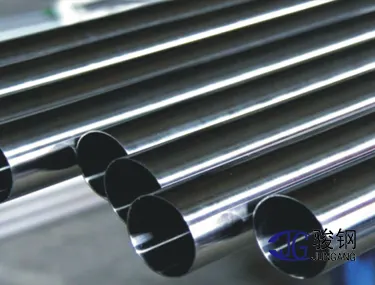
Cold-drawn seamless stainless pipe is defined by the finished size, the condition and the inspection you write down. “Cold drawn” describes a forming route. It is not a grade, a corrosion guarantee or a tolerance class. Two offers can both say cold drawn and still differ in outside diameter, wall basis, heat treatment, surface and the standard that will be used for acceptance.
Junda publishes cold rolling and cold drawing as the cold-forming step in its seamless route. The published equipment count is seven precision cold-rolling mills and seven cold-drawing machines, followed by solution heat treatment, pickling, straightening, cutting and inspection. Manufacturing process Those counts show what the works lists. They do not assign a machine to your item, and they do not mean every catalogue product is cold drawn to the same tolerance.
How does cold finishing differ from the pipe name?
Start with the product form. Seamless pipe begins as a hollow without a longitudinal weld. Cold drawing pulls that hollow through a die, usually over a mandrel or plug when the bore must be controlled. Cold rolling reduces the section in a roll stand. Both are cold-finishing methods. They can be used in sequence. Neither word selects 316L, duplex or a nickel alloy, and neither word sets the allowable ovality.
Hot finishing leaves more of the size variation that a later machining allowance or a looser piping tolerance can accept. Cold finishing is how mills reach a tighter outside diameter, wall or surface for precision tube, instrument tube and some exchanger tube. The finished drawing still has to say which dimension is the datum. An outside-diameter datum with a nominal wall is a different product from an inside-diameter datum with a minimum wall. The precision tubing guide shows how those choices stack.
Use dimensions the standard you named actually recognises. ASME B36.19M covers dimensions of welded and seamless wrought stainless steel pipe and distinguishes pipe from tube. It does not certify a mill, and this article does not copy its table. If you order by NPS and schedule, cite the edition and write the schedule you mean. If you order tube, write outside diameter and wall in millimetres or inches and state the tolerance. The pipe and tube guide separates those two languages. Mixing them in one line item is a common way to receive the wrong bore.
Why is “heavily cold worked” a different phrase?
The public scope of ASTM A312/A312M-25 describes seamless, straight-seam welded and heavily cold worked welded austenitic stainless steel pipe for high-temperature and general corrosive service. Read on 26 October 2026, that scope uses three descriptions. “Heavily cold worked” sits with the welded description. It is not a synonym for a seamless hollow that was cold drawn to finished size.
When you want seamless cold-finished pipe, write seamless, and write the finishing route you require: cold drawn, cold rolled, or either if you can accept both. When a standard uses “heavily cold worked” as its own product class, use that term only if the project specification does. Do not let a quotation replace one class with the other because both involve cold deformation. The A312, A269 and A213 comparison is the place to confirm which document you are in before you argue about the route.
What should the size line contain?
Write the finished size, not the mother-tube size, unless you are buying hollows for your own drawing. For each item include:
- Outside diameter and tolerance, or the NPS and the dimension standard.
- Wall thickness, whether it is nominal, minimum or average, and the tolerance.
- Inside diameter only if it is a controlled dimension. If both OD and ID are toleranced, check that a wall still exists inside those limits.
- Length, cut tolerance and whether ends are plain, bevelled or faced.
- Straightness, ovality and surface, if they affect assembly.
- Quantity as pieces, total length or mass, and the mass formula if mass is commercial.
An illustrative mass, not a quoted weight, uses the planning identity for a round tube:
kilograms per metre ≈ π × wall × (outside diameter − wall) × density / 1000
Outside diameter and wall are in millimetres. Density is in grams per cubic centimetre. For a 25.0 mm outside diameter and a 2.0 mm wall, with an illustrative austenitic density of 7.93 g/cm³:
π × 2.0 × (25.0 − 2.0) × 7.93 / 1000 ≈ 1.15 kg/m
The arithmetic is 3.1416 × 2 × 23 × 7.93 / 1000. It is a planning figure so two offers can be compared on the same basis. It is not the certified mass of a heat. Density changes with grade. Duplex and nickel alloys are not 7.93 g/cm³. If the contract uses mass, state the density or ask the mill to show the formula. A 10 percent difference in invoiced mass is often a formula difference, not a missing length.
The same arithmetic shows why cold finishing is specified on thick-wall hollows that will be machined. If the finished part needs a bore and an outside diameter, the starting tube needs stock on both. The thick-wall allowance note works that backwards from the finished part. Do not add a machining allowance by ordering the next schedule up and hoping the bore is large enough.
What condition follows cold work?
Cold drawing hardens austenitic stainless steel and changes its dimensions. Many product specifications require a final solution heat treatment unless the order says otherwise. Do not assume the treatment from the word “cold drawn”, and do not assume it was skipped because a mill owns a furnace. Junda publishes two solution-heat-treatment lines in the route after cold forming. Ask, for the item you are buying, whether solution treatment is included, what the required condition is called in the standard, and which document will report it.
Surface is a separate line. The published route includes six pickling systems. Pickling removes scale. It is not the same instruction as a polished bore, a bright finish or a passivated surface. The pickling and passivation guide separates those words. If a heat-exchanger or instrument tube must be free of drawing lubricant, say how that will be checked. “Pickled” on a certificate does not describe roughness.
Straightening is also published, with four machines. Straightening can move a thin wall or a tight ovality. If straightness and ovality are both tight, say which one governs and whether straightening is allowed after the final size check. The thin-wall inspection note is the companion for that argument.
Which catalogue entry is the closest starting point?
Junda’s precision-tubing group is the catalogue home for cold-finished sizes that are not ordinary piping lengths. Use the entry that matches the geometry, then overlay your standard.
| Geometry you need | Catalogue entry to open | What you still must specify |
|---|
| Tight OD, wall or surface | Precision tubing and the thin-wall or thick-wall image | Datum, tolerances, condition, surface |
|---|
| Long single lengths | Extra-long tube | Maximum length, straightness, transport |
|---|
| Ordinary piping sizes | Austenitic pipe group | Standard, NPS or OD, schedule or wall, seamless |
|---|
| Exchanger U-bends or rectangular profiles | Profile tubing, covered in the heat-exchanger guide | Drawing dimensions after forming |
|---|
The company range φ6–φ630 mm outside diameter and 0.2–80 mm wall is the published company window, not a statement that every combination is cold drawn, in stock, or qualified to your standard. Annual capacity above 10,000 tonnes is a company total. Ask for the offered size and quantity in the reply.
What inspection belongs with a cold-finished order?
Cold finishing changes which measurements are worth taking. At a minimum, decide:
- Dimensional sample size for OD, wall, ovality, straightness and length.
- Whether wall is measured by micrometer, ultrasonic instrument or mass, and how disputes are resolved.
- Surface inspection method and the defects that are rejectable. A drawing line is not the same as a pit.
- The product tests the standard already requires, such as hydrostatic, eddy current or mechanical tests, and any supplementary test you are adding.
- The heat-treatment and chemical-analysis documents that must name this heat.
Junda’s published testing list includes chemical analysis, ultrasonic and eddy-current equipment, hydrostatic testing, mechanical testing and metallography. Testing capabilities Listing a method means it can be discussed. The order decides whether it is mandatory, how much of the length is covered and what the acceptance numbers are. Eddy-current coverage for tube is discussed in the eddy-current guide. Do not add every available test by default. Add the test that answers a real acceptance question, and say so before production.
Send the finished size, the route constraint, the condition and the inspection list through the contact page. Ask the reply to repeat those four items and to mark any substitution. A quotation that only says “cold drawn stainless pipe, export packing” has not yet answered the enquiry.