Tubing & fabrication
Precision Stainless Steel Tubing: Specify the Dimensions That Matter
Define OD, ID, wall, ovality and straightness for precision stainless tubing, with an illustrative tolerance stack and drawing review checklist.
Define U-tube bend radius, leg spacing, lengths and final inspection, with an illustrative centreline geometry calculation for a semicircular bend.
Junda Pipe
Published Reviewed
Bring this article into your own conversation.
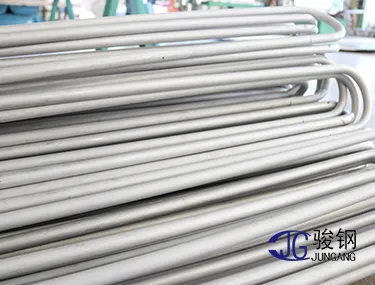
A stainless steel U-tube enquiry should define tube OD and wall, bend centreline radius, leg spacing, straight lengths, end alignment and required inspection after forming. A photograph or the words “U-shaped tube” cannot establish those dimensions.
Junda lists a stainless steel U-pipe entry. Catalogue source Use a controlled drawing to confirm whether the required tube geometry, grade and inspection scope can be supplied.
For an ideal 180-degree semicircular centreline bend, leg centreline spacing equals 2R, where R is the centreline radius. The curved centreline length equals πR.
For an illustrative R = 100 mm and two straight legs of 1,000 mm measured from the bend tangent points:
| Geometric quantity | Calculation | Result |
|---|---|---|
| Leg centreline spacing | 2 × 100 | 200 mm |
| Curved centreline length | π × 100 | Approximately 314.16 mm |
| Total centreline length | 1,000 + 1,000 + 314.16 | Approximately 2,314.16 mm |
This is ideal geometry, not a cutting instruction or a confirmed bend capability. Forming allowances, end trimming and the actual bend profile require the manufacturer’s process review. Label whether a drawing dimension refers to a centreline, inside surface or outside envelope.
Specify whether legs are equal, how straight lengths are measured and where end faces must align. Include tolerances, required end preparation and any assembly datum. If a bundle contains different bend radii, give each configuration a separate identifier and quantity.
State the required material and product standard. ASTM A213/A213M-25 covers seamless boiler, superheater and heat-exchanger tubes, but the full equipment requirements must establish what applies before and after bending. A straight-tube certificate alone does not describe every finished U-tube feature.
Separate starting-material acceptance from final geometry and inspection. The project should define any required wall measurement in the bend, ovality, surface examination, thermal treatment, pressure or nondestructive examination and documentation.
| Stage | Question to close |
|---|---|
| Before forming | Does the starting tube meet material, dimensions and condition requirements? |
| After forming | Does the bend and leg geometry meet the drawing? |
| Final examination | Which required tests cover the finished configuration? |
| Release | Can each configuration and batch be traced to its records? |
This table requests a plan; it does not assert that every listed examination is mandatory. Agree the plan under the selected product and equipment specifications. ASTM A1016/A1016M-24a provides the requirement hierarchy for the tube standards it covers.
Provide the drawing revision, material requirement, configuration list, quantities, inspection plan and packing constraints through the Junda contact page. Ask for proposed deviations in writing. For long straight starting lengths, coordinate the length and delivery review with the final U-tube geometry.
Links to standards bodies and material producers are provided for reference. Confirm the applicable edition, project requirements and acceptance documents for each order.
Tubing & fabrication
Define OD, ID, wall, ovality and straightness for precision stainless tubing, with an illustrative tolerance stack and drawing review checklist.
Tubing & fabrication
Prepare thin-wall tubing requirements for geometry, end condition, inspection coverage and packaging, with a receiving inspection sequence.
Tubing & fabrication
Use finished OD, bore and machining allowances to define thick-wall stainless pipe stock, with an illustrative geometry calculation.
Send the grade, dimensions, quantity and required documents with your enquiry.