
Material selection
How to Select Austenitic Stainless Steel Pipe
Choose an austenitic stainless steel pipe by service conditions, product standard and inspection needs, with a practical material screening table.
Separate cleaning, descaling, pickling and passivation requirements, and agree surface acceptance without relying on appearance alone.
Junda Pipe
Published Reviewed
Bring this article into your own conversation.
Pickling is a chemical descaling process used to remove scale from stainless surfaces. Chemical passivation treatments address surface contamination, with verification focused particularly on contaminant iron and other foreign matter. They serve different purposes, so specify the required surface condition, treatment scope and acceptance method rather than treating the two terms as interchangeable. A380 abstract A967 scope
A purchase line that says only “pickled and passivated” can leave the internal surface and final acceptance undefined. A380 discusses broader surface preparation, while A967 addresses chemical passivation treatments and their effectiveness tests. Read the selected procedure and scope before using either designation in an order.
| Condition or requirement | What to define in the enquiry |
|---|---|
| Oil, grease or other residues | Required cleanliness and agreed cleaning method |
| Scale or heat-related surface condition | Applicable removal process and final acceptance |
| Contaminant iron | Agreed treatment and verification method |
| Specified appearance or roughness | Measurable requirement, location and inspection method |
| Internal service cleanliness | Bore coverage, final handling and protection requirements |
The table identifies questions to resolve; it does not prescribe chemical concentrations, treatment temperatures or a workshop recipe. Select a procedure suitable for the material, product and application.
A380 discusses surface contaminants that can affect corrosion resistance, process cleanliness or equipment operation. Its scope specifically excludes mill descaling and cleaning as general coverage, although some practices may be applicable. Therefore, do not claim that every mill pickling process is certified by citing A380 alone. Scope 1.1–1.3
A967 describes alternative passivation treatments and qualitative tests intended to confirm effectiveness, particularly removal of contaminant iron and other foreign matter. It also states that it does not recommend a grade, treatment or acceptance criterion for a particular application. Scope 1.1–1.4
Those limits matter: passing a surface-treatment test does not establish compatibility with every process fluid or prove a particular service life.
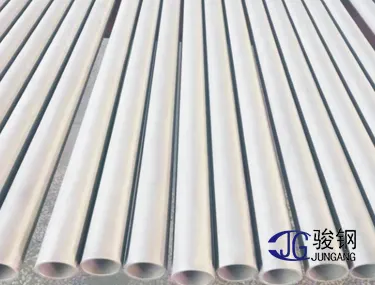
A photograph can document visible condition at a particular location and time. It does not establish chemical cleanliness, internal coverage or compliance with an unspecified test. Use appearance requirements where they are relevant, but keep them separate from the treatment record and acceptance method.
Define whether inspection covers OD, ID, ends, weld regions or all required surfaces. State sampling, acceptance criteria and the treatment stage. If later fabrication changes the surface, identify who is responsible for the final treatment and verification.
Junda’s published production process includes pickling. This does not establish that a particular order includes a specified chemical passivation treatment, an A967 test or a particular surface roughness.
Provide the product, grade, dimensions, desired surface condition, treatment specification and inspection requirements through the contact page. Ask for written confirmation of the proposed process and any exclusions. For welded installations, coordinate this requirement with the 316L fabrication review so final surface responsibility is clear.
Links to standards bodies and material producers are provided for reference. Confirm the applicable edition, project requirements and acceptance documents for each order.
Material selection
Choose an austenitic stainless steel pipe by service conditions, product standard and inspection needs, with a practical material screening table.
Standards & sizing
Understand NPS, outside diameter and wall thickness before ordering stainless steel pipe or tube. Includes an illustrative bore calculation.
Standards & sizing
Compare the published scopes of A312, A269 and A213 and turn a stainless pipe or heat-exchanger tube request into a clear purchase description.
Send the grade, dimensions, quantity and required documents with your enquiry.