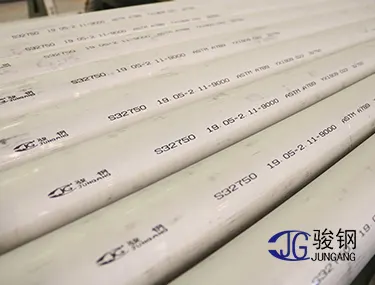
Specify ASTM A790/A790M (UNS S32750) for super duplex wrought pipe, ASTM A789/A789M for tubing, and ASTM A995/A995M (Grades 5A or 6A) or A890/A890M for pressure-containing and general-application castings. Each ASTM specification defines its own product scope, chemical composition, mechanical acceptance limits, nondestructive testing basis, and traceability markings.
Foundries quoting A995 Grade 6A (UNS J93380, CD3MWCuN) or Grade 5A (UNS J93404, CE3MN) and pipe mills quoting wrought UNS S32750 supply distinct metallurgical products under separate standards. Castings have lower minimum yield strengths and different alloying limits than wrought pipe, so an engineering order written with a cast designation cannot certify wrought pipe, and wrought pipe stress allowables do not apply to cast components.
Scope of super duplex casting specifications
The term "super duplex casting" identifies a cast product form within a high-alloy corrosion family rather than an individual material grade. This alloy family covers ferritic-austenitic stainless steels formulated with roughly 25% chromium, 3.5–4.0% molybdenum, and 0.25–0.27% nitrogen to resist localized pitting in chloride environments, as summarized in the IMOA duplex stainless steel overview. Drawings and equipment catalogues sometimes print the one-word spelling "superduplex", while the specific component form determines the governing ASTM standard.
ASTM A995/A995M covers castings for valves, flanges, fittings, and other pressure-containing parts. Its grades use numeric designations such as 5A and 6A alongside Alloy Casting Institute (ACI) names and cast UNS J-numbers, and the purchaser selects the exact grade on the order. ASTM A890/A890M covers duplex castings for general industrial equipment. Pipe falls outside both casting standards.
A995’s scope omits a fixed ferrite acceptance limit. It notes that the grades develop about 30% to 60% ferrite and restricts service temperatures below 600°F (315°C) to avoid embrittling phases. Each casting undergoes solution heat treatment followed by water quenching or rapid cooling by another method.
Wrought tubular standards cover a distinct manufacturing route. ASTM A790/A790M governs seamless and straight-seam welded ferritic/austenitic pipe welded without filler metal, requiring tension, flattening, hydrostatic, and nondestructive electric tests. ASTM A789/A789M governs seamless and welded tubing, defaulting to an average-wall thickness tolerance unless the purchase order specifies a minimum-wall basis.
Cast and wrought designations side by side
Each A995 grade has an ACI name and a cast UNS J-number. The pipe grade has a wrought UNS S-number.
| Product form | Specification | Grade and designation | Wrought reference in the foundry data |
|---|
| Casting for pressure-containing parts | ASTM A995/A995M | Grade 5A, ACI CE3MN, UNS J93404 | S32750 |
|---|
| Casting for pressure-containing parts | ASTM A995/A995M | Grade 6A, ACI CD3MWCuN, UNS J93380 | S32760 |
|---|
| Pipe | ASTM A790/A790M | UNS S32750, 2507, 1.4410 | N/A |
|---|
| Tube | ASTM A789/A789M | UNS S32750, 2507, 1.4410 | N/A |
|---|
The wrought reference column reflects a foundry’s comparison for general alloy pairing, while the ASTM standards treat cast and wrought designations as separate specifications. The foundry pairs CD3MWCuN (Grade 6A) with wrought S32760, and pairs A995 Grade 5A (CE3MN) with wrought S32750.
Chemical and mechanical limits illustrate the gap between the cast and wrought specifications:
| Requirement | A995 Grade 5A (CE3MN) | A995 Grade 6A (CD3MWCuN) | A790 S32750 pipe |
|---|
| Chromium | 24–26% | 24–26% | 24–26% |
|---|
| Nickel | 6–8% | 6.5–8.5% | 6–8% |
|---|
| Molybdenum | 4–5% | 3–4% | 3–5% |
|---|
| Nitrogen | 0.10–0.30% | 0.20–0.30% | 0.24–0.32% |
|---|
| Minimum yield | 75 ksi (517 MPa) | 65 ksi (448 MPa) | 550 MPa (80 ksi) |
|---|
| Minimum tensile | 100 ksi (689 MPa) | 100 ksi (689 MPa) | 800 MPa (116 ksi) |
|---|
| Minimum elongation | 18% | 25% | 15% |
|---|
The cast values are the foundry’s published limits, and the pipe column is Junda’s product data.
Grade 6A also includes 0.50–1.00% tungsten and 0.50–1.00% copper. S32750 pipe limits copper to 0.50% maximum and leaves tungsten unspecified. Drawings that state only "super duplex" omit these alloying differences.
The casting grades specify lower minimum yield strengths than wrought S32750 pipe and require different elongation minimums. Piping stress calculations based on S32750 wrought allowables exceed the certified minimums of A995 castings.
Separation of cast and wrought pipe specifications
The product standard governs the mill test certificate. ASTM A790/A790M covers seamless or straight-seam welded pipe tested as tubular product. ASTM A995/A995M covers pressure-containing castings tested from cast test blocks. A pipe mill certifies pipe strictly to A790/A790M, and a foundry certifies castings to A995/A995M. If a vendor quotes "A995 pipe", verify the exact ASTM product specification printed on the mill test certificate.
The grade designation follows the same boundary. UNS S32750 is a wrought designation. Entering S32750 on a casting requisition leaves the A995 grade (such as 5A or 6A) undefined. Entering "A995 6A" on a piping requisition leaves the wrought pipe grade undefined.
Testing requirements diverge between the two forms. A995’s abstract specifies heat and product chemical analyses alongside a tension test. A790’s abstract specifies tension, flattening, hydrostatic, and nondestructive electric tests performed on the pipe. Because the mechanical properties derive from different manufacturing routes, a test certificate for one form applies only to that form.
Traceability markings follow the governing product standard. A890/A890M requires castings to be stamped or cast with the specification designation and grade. Pipe marking follows A790 and its general requirements standard, A999/A999M. A casting heat number tracks a foundry melt, whereas a pipe heat number tracks a wrought mill melt. The certificate chain must match the supplied component form.
Heat-treatment records also apply strictly to the tested lot. Both product forms undergo solution annealing and rapid cooling, but furnace charges, section thicknesses, and quench rates are recorded against separate production lots. A995 specifies water quenching or rapid cooling by another method for cast sections, while A790 pipe is solution annealed and quenched as tubular product.
Where castings and wrought pipe meet
A995 covers cast valves, flanges, fittings, and pump casings, while wrought standards cover process line pipe, seawater headers, and heat exchanger tubing. Piping packages routinely combine both forms, so the bill of materials must assign the exact specification to each tag.
Welding a cast valve body to wrought S32750 pipe creates a dissimilar-grade joint when Grade 6A (CD3MWCuN) castings are used. Grade 6A contains intentional tungsten and copper additions that are absent in S32750 pipe. A welding procedure qualification record (PQR) qualified strictly on S32750-to-S32750 pipe does not cover a weld to an A995 Grade 6A casting. Require a PQR qualified across the specific cast and wrought grades in the joint.
Fittings and flanges divide across three ASTM standards. Cast fittings are ordered to A995/A995M. Wrought butt-welding fittings of seamless or welded construction are ordered to A815/A815M. Forged or rolled pipe flanges and forged fittings are ordered to A182/A182M. Engineering drawings that label a part simply as a "fitting" must be clarified by specifying A995, A815, or A182 on the requisition.
Transfer errors often pull valve body designations onto piping requisitions. When a buyer copies "CD3MWCuN" from a valve drawing onto a pipe line item, the pipe mill must issue a technical clarification and quote wrought UNS S32750 or S32760 to ASTM A790. Naming the wrought UNS grade directly on the piping line items prevents bid delays.
Required fields on a wrought super duplex pipe order
On a wrought pipe requisition, state the wrought UNS designation and pipe standard directly. Include the following parameters on the purchase order:
| Field | What to write | Why it matters |
|---|
| Grade and UNS | UNS S32750, 2507 | The UNS number fixes the wrought chemistry, and 2507 is the common trade name |
|---|
| Product standard and edition | ASTM A790/A790M-26 for pipe, A789/A789M-26 for tube | The edition fixes the test schedule and dimensional tolerances |
|---|
| Size | NPS and schedule to ASME B36.19M, or OD and wall in millimetres | A790 permits custom dimensions when the pipe meets all other standard requirements |
|---|
| Wall basis | Average wall or minimum wall, with the tolerance | The wall basis governs the allowable design pressure calculation |
|---|
| Heat treatment | Solution anneal and rapid quench | 2507 is annealed at 1,050–1,120°C, because intermetallic phases form between 600 and 1,000°C |
|---|
| Testing | Hydrostatic and nondestructive electric tests to A790, plus ASTM A923 or E562 when required | Supplementary phase and corrosion tests require explicit callouts on the order |
|---|
| Certificate | EN 10204 Type 3.1 with heat number, chemistry, mechanical results, and heat-treatment record | The certificate must reconcile directly with the physical pipe stencil |
|---|
| Length and ends | Random or fixed length, plain or beveled | The mill requires the cut length and end preparation to calculate yield and pricing |
|---|
The wall thickness basis and supplementary testing scope establish the pressure rating and mill production cost. Define both parameters in the initial request for quotation.
When the project specification requires a ferrite-austenite phase-balance check, specify ASTM E562 along with the acceptable ferrite percentage range. When the project requires detrimental intermetallic phase screening, specify ASTM A923 and state Method A, B, or C. A923 notes that routine chemical and tensile compliance alone does not verify the absence of brittle intermetallic phases, so the order must explicitly mandate the A923 method.
Verify traceability at receiving inspection by matching the stenciled heat number and ASTM specification on the pipe against the EN 10204 Type 3.1 certificate. The material certificate guide details the complete document verification steps.
Junda wrought super duplex supply scope
Junda manufactures wrought UNS S32750 super duplex pipe and tubing to ASTM A790/A790M and ASTM A789/A789M. Review the dimensional range and chemical limits on the S32750 super duplex pipe page, and inspect our ultrasonic, eddy current, and hydrostatic test benches on the testing capabilities page. Junda focuses exclusively on wrought tubular products, while A995 and A890 castings are sourced from valve and pump foundries.
Submit your wrought pipe and tubing schedule through the contact page, and indicate clearly if your package includes separate cast component items.